|
I wanted to share something about my employment journey over the last 10+ years including my successes and setbacks in the hope that it will help me to forge a new path forward or find a way to continue this one.
From 2010-2015, I was working seasonally as a National Park Service backcountry ranger in Alaska (in my late 20s) with intermittent college teaching in the winters. My time was roughly split between running a permit office and backpacking to ensure visitors were adhering to their permits and following regulations so that the park remained in good condition long into the future. This work was primarily about people management. I had a master’s degree and was thus overqualified but drawn to the grandiosity of wild nature and the thrill of exploration. The work was rewarding in a way but not intellectually challenging, nor did I see a clear pathway towards stable, long-term employment, and so, after a few seasons, I managed to get accepted into a PhD program in Environmental Studies. I was thrilled. I saw this as getting serious about life and preparing for stable, professional work (in my 30s). The program itself was difficult, in some good and bad ways. On the plus side, I learned a lot and had old ideas challenged and clarified. Being tethered to a large research university, and in a graduate program in general, offered unique funding opportunities, which I eagerly applied for and worked hard to complete to make sure the program would pay off with lasting, meaningful work once I finished. I received a Pulitzer Center summer reporting fellowship to investigate Greenland (years before Trump made it a headline) and also to attend and report on COP26 in Glasgow, I received a Nature Environment Science and Technology (NEST) grant to bridge art and science, I worked for six-months as a Society for Wilderness Stewardship Wilderness Fellow, and spent a summer in Arctic Alaska as a National Park Service Young Leaders in Climate Change intern (now Scientists in Parks). I was sure one of these would open a substantive path: reporting, writing, government, research, photography? On the negative side, there was no guaranteed funding to cover tuition and expenses beyond an initial two-year contract. Every semester beyond two years, I had to scramble and hope that I wouldn’t be on the line for expensive tuition and no income. I got lucky and managed to find a teaching assistant position every semester, though I covered a brand-new class nearly every time for about four years, necessitating a lot of work mastering the material well enough to offer quality grading and assistance. This added a lot of time and stress to the process. A PhD is inherently difficult and the process, even without these local proclivities, was stressful and taxing. But I managed and completed the program in December 2021. The semester immediately following, I had a reality shock when suddenly I was unaffiliated with any institution and without work. I used the time to refine my application materials and write. In the following fall, I found an adjunct position to teach one course at the Colorado School of Mines. The following semester, I lucked into a full-time, but only one-semester, teaching assignment at Rocky Mountain College, followed immediately by my biggest breakthrough: a one-year Fulbright Scholar position in Iceland until August 2024. I was sure this would kick the doors open, and I would now be set with lasting employment. This has not thus far proven to be true. Following this Fulbright, I was unemployed for nine months—a dark period. The combination of the Fulbright and the time off allowed me to publish about five academic articles and chapters. I kept playing the game. This period ended when I returned to seasonal NPS employment in summer 2025. I had another breakthrough with an offer to teach a course as an instructor for the University of California San Diego in spring 26. I spent about a year preparing, investing countless hours in creating a quality course. I took another seasonal job for summer 26. I saw this as a workable, if not ideal, combination. I would have university affiliation and the ability to continue to refine my teaching and stay engaged in academic material, while having moderate year-round income. Though without benefits, or a truly livable income (with which to ever buy a house for instance). However, I learned last month that budget cuts across the UC system would not allow my course to take place in the upcoming academic year. This felt like a death blow, straight into my heart, beyond all prior challenges and setbacks, spiraling me into a cycle of anger and sadness I have not yet escaped. Countless times since beginning and completing the PhD, I contemplated giving up on academia. But I kept at it, moving from cookie crumb to cookie crumb. Then my final cookie crumb disappeared, leaving me with a seasonal job making less that I have since 2011, with no obvious viable path toward anything higher and deeper. Of course, the current political situation in this country is not helping. Should I keep applying, keep writing, keep putting my own money into attending conferences? What would giving up even look like? My resume has become immense and enviable. How can things possibly end like this, given all that I have accomplished so far? Now I am in my 40s and time is running out to accomplish some key life goals. The instability, while allowing me to take opportunities far and wide, has cost me a lot, in relationships (this is probably the primary cost), in life quality by certain measures (while enhancing others), in the ability to retain momentum on a given project, thus sometimes leading to dropping intended publications merely because I had to throw my time and energy into my next temporary income source, which, by the time I completed and had to move on to the next thing, put the project just far enough past the horizon to make continuing it exceedingly difficult. I write this in the hope that someone will read it and care. And maybe it will open something new.
0 Comments
"Socrates could never get tenure in a philosophy department today. That Socrates could never get tenure today is an indictment of the system--a reductio ad absurdum--not an indictment of Socrates" "my hearers always imagine that I myself possess the wisdom which I find wanting in others: but the truth is...the wisdom of men is little or nothing" --Socrates (-470 -- -399)  This New York Times opinion piece, When Philosophy Lost its Way, is a fantastic take on the often-dismal state of contemporary philosophy.
"There was a brief window when philosophy could have replaced religion as the glue of society; but the moment passed. People stopped listening as philosophers focused on debates among themselves." "Having adopted the same structural form as the sciences, it's no wonder philosophy fell prey to physics envy and feelings of inadequacy. Philosophy adopted the scientific modus operandi of knowledge production, but failed to match the sciences in terms of making progress in describing the world. Much has been made of this inability of philosophy to match the cognitive success of the sciences. But what has passed unnoticed is philosophy's all-too-successful aping of the institutional form of the sciences. We, too, produce research articles. We, too, are judged by the same coin of the realm: peer-reviewed products. We, too, develop sub-specializations far from the comprehension of the person on the street. In all of these ways we are so very 'scientific.'" "I am, alas, destined for a career that distracts me terribly from my studies.” --Alexander Von Humboldt (1769-1859) Alexander longed to live "far away from the so-called intellectuals." “There was still an instinctive wariness of his brother’s more analytical way of thinking, and ‘the knack that logical reasoning has to kill off the spirit and the imagination’.” “While [Alexander's brother] was in the process of arranging his life down to the colour of his teapot, Alexander seemed to recoil instinctively against everything conventional and regimented.” 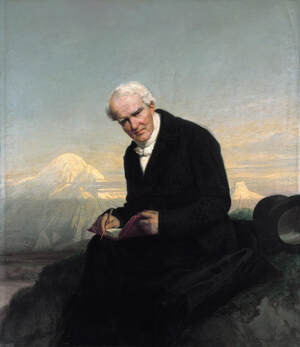 |
Chris Dunn, PhD
Researcher, writer, explorer*, photographer, thinker. Wrestling with nature, culture, technology. Archives
November 2026
*When I use the term "exploration", I mean it in a personal sense (discovery for myself, or at a unique moment in time [everywhere after all--even crowded cities--endlessly await rediscovery--by new eyes and in new moments]), not in an absolute sense. With few exceptions (notably Antarctica), almost everywhere on earth has had other people around for a long time (though to varying degrees - high mountain tops or places like the interior of the Greenland Ice Sheet for instance were far less visited and populated, and undoubtedly at least some pockets of the earth were never visited or populated). It is an enlightening experience though when on an isolated ridge in what feels like the middle of nowhere to wonder if anyone has set foot there but never knowing for sure. What is significant is that the landscape itself is left in such a condition that it isn't evident. Some places ought to be kept that way.
|
 RSS Feed