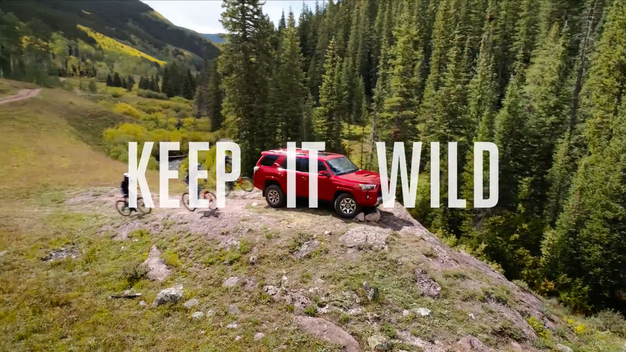
 From: https://vimeo.com/239874194 From: https://vimeo.com/239874194 I rarely watch television, and if I do, I make a superhuman effort to avoid advertisements. I happened though to catch a few of the recent Stanley Cup games in a Denver restaurant in which I controlled neither the channel nor the volume, and one commercial for a Toyota 4Runner stood out to me. It featured said machine (shiny and new of course) blasting up roads in a natural setting, with a deep male voice narrating something or other, and generic guitar riffs in the background.
It culminated with the 4Runner at a scenic view with the massive words “Keep it Wild” plastered across the screen overtop the vehicle and scenery. After some internet searching, I discovered that Toyota has been running this campaign for around 10 years, if not more. I have no specific beef with Toyota (well, besides their financing of Big Lie supporting politicians and mixed environmental record). I actually own a Toyota—a 2000 Tacoma to be exact—a real truck if there ever was one. It’s less than ideal in terms of gas mileage and for city driving (I try to drive it as little as possible, choosing to bike, bus, and carpool instead), but it delivers for camping and getting into the mountains. I suppose that is the point of the ad campaign. Nevertheless, Toyota’s slogan sits somewhere between irresponsible and insulting. If the wild is anything, it is beyond the limits of motorized access. To be clear, the wild is in a sense everywhere—the weeds in your driveway, the moon looming above a city skyline, the hummingbird flitting by your window—each are wild things that all of us experience every day. But the real stuff—intact landscapes where a variety of creatures, large and small (including predators), can live their lives more or less as they have for eons with minimal human interference and influence—and, once entered by humans on their own two legs or with paddle in hand or on horseback, know that this is a realm apart from their usual world—a place that commands respect in part because it is dangerous and is not theirs to command—a place that overwhelms sense and sensibility with an order apart. More practically speaking, wilderness means in part a specific form of land designation that legally bars road development and mechanized and motorized intrusion. The 1964 Wilderness Act was motivated largely by the threats that these created to the last remaining undeveloped federal lands—usually in the most rugged mountains or most remote deserts. I for one am bounteously grateful for the foresight of those over 50 years ago to leave some places protected as such—a respite from the noise, emissions, and consumptive ease of the everyday. Presently, around 2% of all the land in the “lower 48” is protected as wilderness. The rest is within striking distance of a road and otherwise converted for human uses. But even with a variety of protections in place against motorized incursion, it is often regarded by land management professionals as an ongoing threat to Wilderness and other public lands, though not among the largest threats to Wilderness. The late environmentalist and author Edward Abbey famously railed against “Industrial Tourism” in the National Parks in his best-known work, Desert Solitaire, arguing among other things that the experience is diminished by being confined to an automobile: “A man [or you know whoever] on foot, on horseback or on a bicycle will see more, feel more, enjoy more in one mile than the motorized tourists can in a hundred miles...Those who are familiar with both modes of travel know from experience that this is true; the rest have only to make the experiment to discover the same truth for themselves.” More important than the quality of the experience of nature is the pressing need to increase the size and interconnectedness of protected landscapes to stymie and reverse biodiversity loss. This will certainly entail decreasing road access in some areas. While slowing climate change (including its profound impacts on wild nature) requires decreasing fossil fuel consumption, which will necessitate—among many other things—slowing the production and dissemination of personal vehicles powered by the internal combustion engine. It is therefore more than a little Orwellian that an automobile company in an SUV ad should help itself to language to which it is totally unentitled. Toyota’s slogan undoubtedly sells 4Runners, but it certainly doesn’t “Keep it Wild.” #wild #wilderness #TOYOTA #keepitwild
0 Comments
|
Chris Dunn, PhD
Researcher, writer, explorer*, photographer, thinker. Wrestling with nature, culture, technology. Archives
July 2024
Categories
All
*When I use the term "exploration", I mean it in a personal sense (discovery for myself, or at a unique moment in time [everywhere after all--even crowded cities--endlessly await rediscovery--by new eyes and in new moments]), not in an absolute sense. With few exceptions (notably Antarctica), almost everywhere on earth has had other people around for a long time (though to varying degrees - high mountain tops or places like the interior of the Greenland Ice Sheet for instance were far less visited and populated, and undoubtedly at least some pockets of the earth were never visited or populated). It is an enlightening experience though when on an isolated ridge in what feels like the middle of nowhere to wonder if anyone has set foot there but never knowing for sure. What is significant is that the landscape itself is left in such a condition that it isn't evident. Some places ought to be kept that way.
|
 RSS Feed